

The India Reliance Ratio: Which Smartphone Brands Actually Need India, and Which Just Say They Do

Updated: Aug 24

Everybody calls India strategic. Very few of them are exposed to it.
Sit through enough brand keynotes in this market, and you will hear the same sentence in five accents: India is our most important market.
It is a nice sentence. It is also, for most of the brands saying it, not true in any way that would show up in a board deck.
So I ran a single number across the top 15 smartphone brands globally, plus Nothing, for calendar 2025. Global shipments from Omdia. India from IDC's brand-level volume share, consolidated the way the market actually behaves rather than the way trackers report it: vivo with iQOO, Xiaomi with POCO, OPPO with OnePlus, and itel, Infinix and TECNO folded back under Transsion.
India Reliance Ratio = India shipments divided by global shipments.
One number. No adjectives. And the spread turns out to be enormous, from 89 percent at one end to a literal zero at the other.
The number itself
Before the interpretation, the arithmetic.
India shipped 152 million smartphones in 2025 per IDC, up a nominal 0.5 percent. The world shipped 1.25 billion per Omdia, up 2 percent. So India is roughly 12 percent of the global smartphone market by volume. That 12 percent is the baseline. Anything meaningfully above it means a brand is over-indexed to India. Anything below means India is, at best, a line item.

Figures marked ~ are triangulated. Ratios rounded to the nearest whole number.
Five tiers, and only two of them are interesting
Sorted by exposure rather than size, the market breaks into five clean groups.
India is the business, above 50 percent. Lava at roughly 89 percent and Nothing at roughly 55 percent. For Lava, this is unremarkable; it is an Indian brand with negligible export volume. Nothing is the genuinely interesting case. A London-designed, globally positioned challenger brand whose growth engine is Indian demand, Indian manufacturing and an RCB jersey. Carl Pei has built something that is, in shipment terms, more Indian than most Indian brands.
Structurally dependent, 25 to 50 percent. realme at roughly 33 percent, vivo at roughly 32 percent. One in every three units. IDC's own phrasing on vivo, that it "remains heavily reliant on India," is not a compliment when the same house is forecasting India to contract in 2026.
Strategic growth engine, 10 to 25 percent. OPPO at roughly 23 percent, Motorola at roughly 17 percent, Xiaomi at roughly 12 percent. Material, not existential. This is the band where India funds growth without owning the P&L.
Incremental by volume, 3 to 10 percent. Google at roughly 9 percent, Samsung at roughly 8 percent, Transsion at roughly 7 percent, Apple at roughly 6 percent.
Effectively absent, below 3 percent. HMD at roughly 2 percent, HONOR below 1 percent, TCL at approximately zero, and Huawei and ZTE at genuinely NA.
The two middle tiers are where the strategy conversations happen. The top and bottom tiers are where the structural stories are.

Where the ratio lies to you
A volume ratio is a blunt instrument, and Apple is the clearest example of where it misleads.
Apple takes 6 percent of its global units from India. On the surface, immaterial. But IDC's own 2025 data shows Apple shipped a record 14 million iPhones here, grew 16 percent year on year, and captured 29 percent of India's market by value while holding only about 10 percent by volume. India is now Apple's fourth-largest market globally after the US, China and Japan, and its fastest-growing top-five market.
Six percent of volume. Nearly a third of the value pool in the world's second-largest market. Those two facts describe the same company.
Samsung sits in a similar but different trap. Its 8 percent India reliance understates a market where India is simultaneously a demand market, a manufacturing base and an export hub. Reading Samsung's India commitment off a shipment ratio is like reading a company's ambition off its office rent.
The lesson is not that the ratio is wrong. It is that the ratio measures exposure, not importance. For most brands those two things move together. For Apple and Samsung they have decoupled entirely.

Transsion's 7 percent is the most under-discussed number in this table
Transsion is the undisputed emerging-market operator. Around 100 million units globally. Dominant across Africa, deeply embedded in Southeast Asia, aggressive in the Middle East and Latin America. Omdia's data showed African shipments surging around 25 percent year on year in Q3 2025 with Transsion doing most of the lifting.
And in India it takes roughly 7 percent of its global volume. Below the market's own 12 percent baseline. India is the one billion-person, price-sensitive, distribution-driven market where the sub-$200 Transsion playbook, the playbook that works essentially everywhere else on earth, did not clear the bar.
The reason is not product. It is that India's entry and mass-budget segments were already occupied by vivo's and OPPO's mainline machinery, and by Xiaomi's and realme's online economics, long before Transsion tried to scale here. Infinix has done reasonable work, overtaking TECNO to become the group's lead brand in India per Omdia's Q2 2025 read. But group-level, India remains Transsion's structural miss.
Every other brand in this table is either present in India or has chosen not to be. Transsion is the only one that tried properly and got outplayed.

The China-brand ceiling is real, and it is entirely post-2020
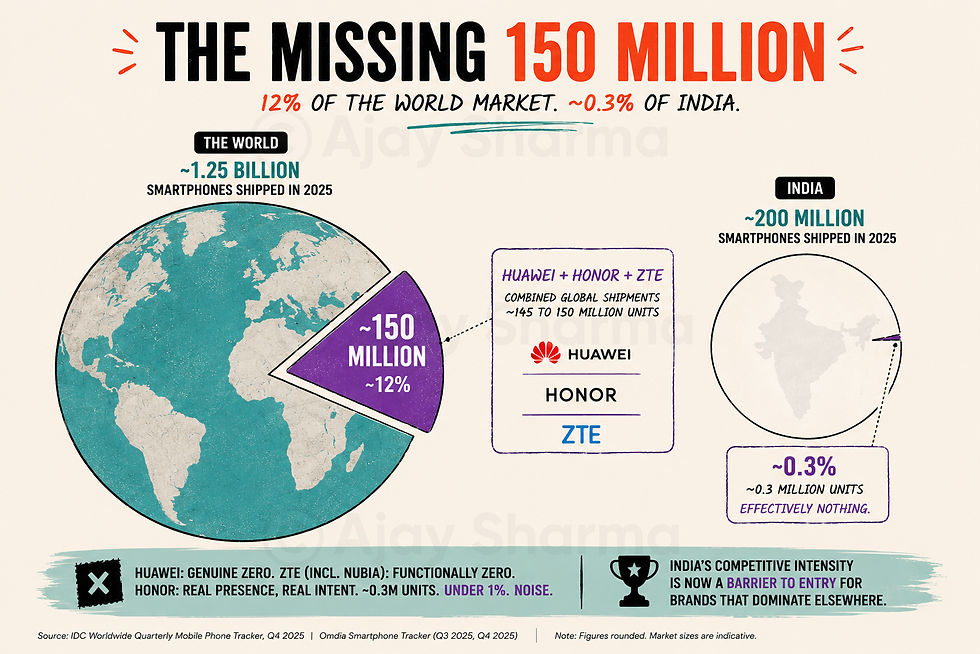
Huawei, HONOR and ZTE ship a combined 145 to 150 million units globally. Between them, they ship close to nothing in India.
Huawei is a genuine zero. ZTE, including nubia, is functionally a zero. nubia has been picking up BIS certifications for a re-entry, but there is no meaningful 2025 shipment volume behind it.
HONOR deserves a correction here, because it is widely assumed to be absent and it is not. HTech has been shipping HONOR in India since 2023. The X9c and X7c landed in 2025, local assembly was targeted from late 2025, and the stated ambition is 1 percent of the Indian market. Real presence, real intent. Just roughly 0.3 million units against a 71 million unit global base, which rounds to under 1 percent and, honestly, to noise.
The blunt version: roughly 12 percent of the world smartphone market has effectively written off the world's number two market. Some of that is geopolitics and some of it is a considered read that the cost of building Indian mainline distribution from scratch, in 2026, is no longer worth the volume on the other side.
Both readings point the same way. India's competitive intensity is now high enough that it functions as a barrier to entry for brands that would walk into most other markets unchallenged.
Xiaomi's de-rating is the biggest single move in this data
Xiaomi at 12 percent India reliance sits exactly on the market baseline, which is a remarkable place for a brand that spent the better part of five years being the definitional Indian smartphone company.
At its peak, India was in the region of a quarter of Xiaomi's global volume. It is now roughly half that. IDC's 2025 read is explicit that Xiaomi's India share declined and that realme, Motorola and iQOO improved their rankings directly into the gap Xiaomi opened.
This is the clearest available evidence that India punished a single-channel identity. Xiaomi built its Indian scale on online-first economics, and India spent 2025 walking away from online. Which brings us to the number that quietly explains half of this table.

Mainline came back, and it hit the high-reliance brands hardest
IDC's 2025 data records something the industry has still not fully absorbed. Mainline shipments grew 12 percent year on year to a 57 percent share, the highest in six years. Online fell 12 percent, with share dropping from 49 percent to 43 percent.
That is not a channel wobble. That is a reset of where conversion and scale sit in this market.
Look at who won 2025 in India, and the pattern is not subtle. vivo, OPPO and Motorola gained share, and all three run retail-first models with real trade margins and distributor relationships. IDC also notes that consistent cross-channel pricing was the unlock; where MOP discipline held, mainline distributors funded the push.
Now overlay that on the reliance ratios. The brands sitting in the two most India-exposed tiers are disproportionately the ones whose Indian volume was built on e-tail economics. POCO, iQOO, realme's online heritage, and to a meaningful degree Nothing. They are highly exposed to a market that is currently shifting share into the half of the channel they are weakest in.
High India reliance plus online skew plus entry-level concentration is not one risk. It is three risks that fire together.

Why concentration stopped being a moat in 2026
Everything above describes 2025. The reason it matters is 2026.
Omdia has been clear that global volumes face contraction on DRAM and NAND cost inflation, and that vendors with smaller scale, weaker long-term supplier relationships, high LPDDR4X exposure and large low-end shares will be hit hardest. IDC's own note is blunter still: the sub-$100 segment, which was over 170 million devices in 2025, becomes economically unviable as memory settles at a permanently higher level.
For India specifically, IDC expects volumes to contract in 2026 while value continues to grow.
Put those together and the reliance ratio stops being a descriptive statistic and becomes a risk-concentration score.
A brand with a third of its global volume in a market that is contracting, in the price bands where memory inflation bites hardest, sold through the channel that lost 12 percent last year, does not have a growth story. It has a correlated bet with good quarterly optics.

The nuanced read
The consensus interpretation of a high India number is that a brand has won India. That reading is incomplete and, in 2026, mildly dangerous.
What the reliance ratio actually measures is how much of a brand's global outcome is hostage to a single market's conditions. In a growth cycle, that concentration is leverage. In a supply-side contraction, it is exposure. India spent 2015 to 2022 being the first thing. It has spent the last eighteen months quietly becoming the second.
For vivo, realme, Nothing and Lava, India is no longer a growth market. It is the risk register.
For Apple and Samsung, India is a value and manufacturing story that a volume ratio cannot see, and both will keep investing here regardless of what a shipment percentage suggests.
For Transsion, HONOR, Huawei and ZTE, India is the market that got away, and the window to change that is narrowing because mainline distribution is now expensive to build and increasingly consolidated among incumbents.
The brands that look smartest coming out of 2026 will not be the ones with the highest India number. They will be the ones that spent 2025 diversifying within India, across price bands and across channels, rather than simply adding units.
Not every 30 percent is a strength. Some of them are just a single point of failure with a good quarterly print.


Comments